How to get to Fire Island

One of our favorite locations on the East Coast is Fire Island. It’s a beautiful, large barrier island just 46 miles from New York City. Despite its proximity to NYC, it’s an oasis of calm, beauty, and nature. However, getting to the island can be more complicated than you imagine. Separated from the mainland by the Great South Bay and with few paved roads, you’ll need to plan ahead if you want to visit. In this article, we’ll look at the different options for getting to Fire Island and how to make the most of your visit.

Where is Fire Island?

Fire Island is a long, thin-barrier island located south of Long Island. Separated from the mainland by the Great South Bay, the island measures 31 miles in length and up to 400 meters in width. It forms part of a barrier island chain that runs most of Long Island’s southern coast. These islands are ephemeral, which means they constantly form, erode and re-form. In fact, Fire Island was divided back into two during Hurricane Sandy in 2012.  

Can you drive to Fire Island?

Despite being situated several miles off the southern coast of Long Island, it is possible to drive to Fire Island. The island is connected to the mainland via 2 bridges at either end of the island. At the western end, the Great South Bay Bridge connects Long Island with Robert Moses State Park on Fire Island. On the eastern end, the smaller Smith Point Bridge connects Smith Point County Park on Fire Island with the mainland. There are large parking lots on the island at both crossing points, as driving across the island is impossible. There are no toll fees for using the bridges, although you’ll need to pay for the parking lots.

Can you drive on Fire Island?

The biggest complication with getting around Fire Island is the lack of roads and the restrictions on driving. Despite the island’s size and several communities on the island, there are no paved roads, and all vehicles require a special permit. These permits are typically restricted only to residents, contractors, and those providing essential maintenance on the island. If you’re coming to the island as a visitor, you won’t be able to obtain a permit. Therefore, you’ll need to leave your vehicle in one of the parking lots close to the bridges or arrive by ferry. 

How to get around on Fire Island

Given the restrictions on driving on Fire Island, the only effective way to get around the island is on foot or by boat. As the island spans 31 miles, it’s highly unlikely you’ll be able to navigate it on foot alone, meaning boat travel is a necessity. The good news is that 3 different ferry services connect various parts of the island with the mainland. See the section below for further details on these routes, frequency, and cost. A water taxi service is also available, which links the main communities and attractions on the island. In total, the Fire Island water taxi services 17 different locations across the island. 

You might consider trying to get around the island by other alternative forms of transportation, but these are also problematic. Currently, bicycles, scooters, roller skates, and rollerblades are prohibited on all park boardwalks. There are also no paved roads or designated bicycle routes on the island, meaning travel on foot or by boat remains the only viable option.

Fire Island Lighthouse and Beach
Fire Island Lighthouse on the western end is the islands most recognisable landmark.

How to get to Fire Island by Ferry

Fire Island is well-serviced by a year-round passenger ferry service. Note no vehicles can travel on any of the ferry services. The destinations and frequency of services vary through the seasons, so we’ll focus on the main tourist summer season, which runs from late June to early September. During this period, 3 separate ferry operators run services out of 3 separate Long Island towns: Bay Shore, Sayville, and Patchogue. While the journey times vary slightly, most trips take around 30 minutes. 

Bay Shore – The most popular service with the most destinations is the Fire Island Ferries, operating out of Bay Shore. Up to 9 daily ferries service Kismet, Saltaire, Fair Harbor, Dunewood / Atlantique, Lonelyville, Ocean Beach, Ocean Bay Park, and Sea View. The first service is typically at 7 a.m., while the last leaves Long Island at 9 p.m., although there are later ferries on weekends and holidays. Adult fares are $13 one way and $25 for a return.

Sayville – The second ferry operator is the Sayville Ferry Service, which operates out of Sayville. It services 4 destinations: Fire Island Pines, Cherry Grove, Sailors Haven, and Water Island. Ferry frequency and times are comparable with Fire Island Ferries, although fares are considerably cheaper at $11 one way or $20 return.

Patchogue – The third and final ferry operator is the Davis Park Ferry, which operates out of Patchogue. Offering only 2 routes to Davis Park and Watch Hill, the operator services the quieter eastern end of the island. Service frequency and times are comparable again for Davis Park, although significantly less for Watch Hill. Fares are also competitive at $11 for a single and $20.75 for a return.

How to get to Fire Island from NYC

There are many ways to get to Fire Island from New York City, particularly during the summer months. The best method will depend on your access to a car, congestion on the roads, and how many of you are traveling. Here are the different ways to get to Fire Island from NYC:

Car – The fastest, most convenient, and probably cheapest way to reach Fire Island is by car. The quickest route by road is to leave Manhattan via the Brooklyn Bridge and pass east through Brooklyn on the I-278 before joining the I-495, which passes through Queens. Leaving at exit 38 you’ll merge onto the Northern State Parkway before joining the Wantagh Parkway South. You’ll then need to merge onto the Southern State Parkway. Depending on where you’re planning to visit on the island, you’ll then either need to:

  1. Park near the port and take a ferry from one of the 3 Long Island towns that service the island 
  2. Drive across either of the 2 bridges that connect the island with the mainland and park in a nearby parking lot.

If you’re heading to the island, you’ll join the Robert Moses Causeway, which takes you onto the island. If you’re heading for one of the ports, you must use the Sunrise Highway before turning off for whichever port you choose. In total, these journeys should take around 2 to 3 hours, although it can take considerably more during rush hour, weekends, and holidays.

Train – If you plan to travel by train, you must depart Manhattan from Penn Station. The Long Island Rail Road (LIRR) is a relatively straightforward journey to the ferry towns of Bay Shore, Sayville, and Patchogue, which are all on the same line. You’ll need to make only one transfer at Babylon. Trains depart every hour, and the journey takes around 90 minutes. 

You can purchase a combined train/taxi/ferry ticket during peak season. Otherwise, you’ll need to walk from the train station to the ferry terminal or take a taxi. It’s these transfers that can sometimes make taking the train a bit of an inconvenience.

Bus / Shuttle – Some private companies offer direct bus services between NYC and the ferry terminals during the peak season. One of the best services is Bay Bus, which connects Midtown NYC with Sayville Ferry Terminal. This direct service eliminates the need for transfers and is a hassle-free alternative to taking the train.

Ferry – There are no direct ferry services from NYC to Fire Island. The only way to reach the island by ferry is by departing from Bay Shore, Sayville, or Patchogue on Long Island. 

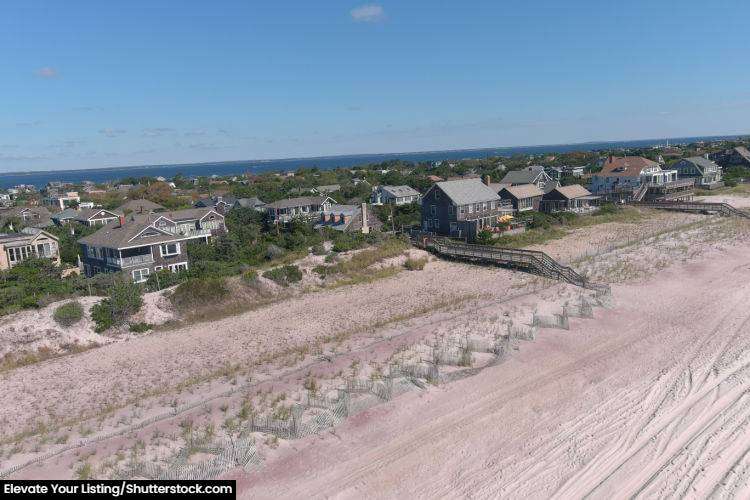
Aerial view of a community on Fire Island
Fire Island is home to 17 different, distinct and quirky communities.

Best time to visit Fire Island

Undoubtedly, the best time to visit Fire Island is during summer. At this time, you’ll be able to make the most of the glorious beaches that the island is renowned for. While this is also peak tourist season, this can be mitigated by heading further east to the quieter end of the island. Visiting outside June, July, and August won’t have the same warm, dry days as summer, but you’ll see far fewer crowds. Visits during the winter are also surprisingly popular. The cold and snow make for a spectacular if desolate setting, providing a very contrasting experience to a visit during the summer. 

Related Content

North America Guide
USA Country Guide
Can you Drive to Nantucket?
3 Days in New York
Can you Drive to Martha's Vineyard?

Latest Blog Posts

Can you Drive to Morocco?

You can drive to Morocco from the neighboring countries of Spain and Mauritania, but not Algeria, despite a nearly 2000 km long border between the two countries. Travel between Morocco and any of its neighbors comes with its fair share of challenges. At first glance, you could be mistaken for

10 Best National Parks in Western Australia

If you love solitude, amazing landscapes, and vast open spaces, you’re going to love Western Australia. This amazing land, and the northwest in particular, is often referred to as the ‘Last Frontier’. It’s a land of endless remote possibilities and nowhere showcases this better than the amazing array of national

17 Best Things to do in Vlore

The Albanian port city of Vlore is one of Albania’s spectacular coastal highlights. Situated at the northern end of the Albanian Riviera and overlooking the beautiful Bay of Vlore, the city is blessed with a wealth of attractions. The home of Albanian independence and the gateway to the Riviera, the

Mastodon