
Unfortunately it’s not possible to drive to Hawaii due to the islands remote location in the centre of the North Pacific Ocean. Located more than 2000 miles off the coast of California, a bridge or tunnel to the islands from the U.S mainland is completely unfeasible. The distance is so great that a ferry service between the U.S. mainland and Hawaii is also completely unrealistic, as it would take over a week to sail between the two locations. This means that the only feasible way to get there is by plane. If you’re adamant you want to get there by boat, you’ll need to travel by cruise ship or on a cargo ship.
The islands of Hawaii are located in the central Pacific Ocean, about 2,000 miles southwest of the mainland United States. Specifically, the Hawaiian Islands are located between 19 and 23 degrees north latitude and 154 and 162 degrees west longitude. The archipelago consists of eight main islands: Hawaii (also known as the Big Island), Maui, Oahu, Kauai, Molokai, Lanai, Niihau, and Kahoolawe, as well as numerous smaller islands and atolls.
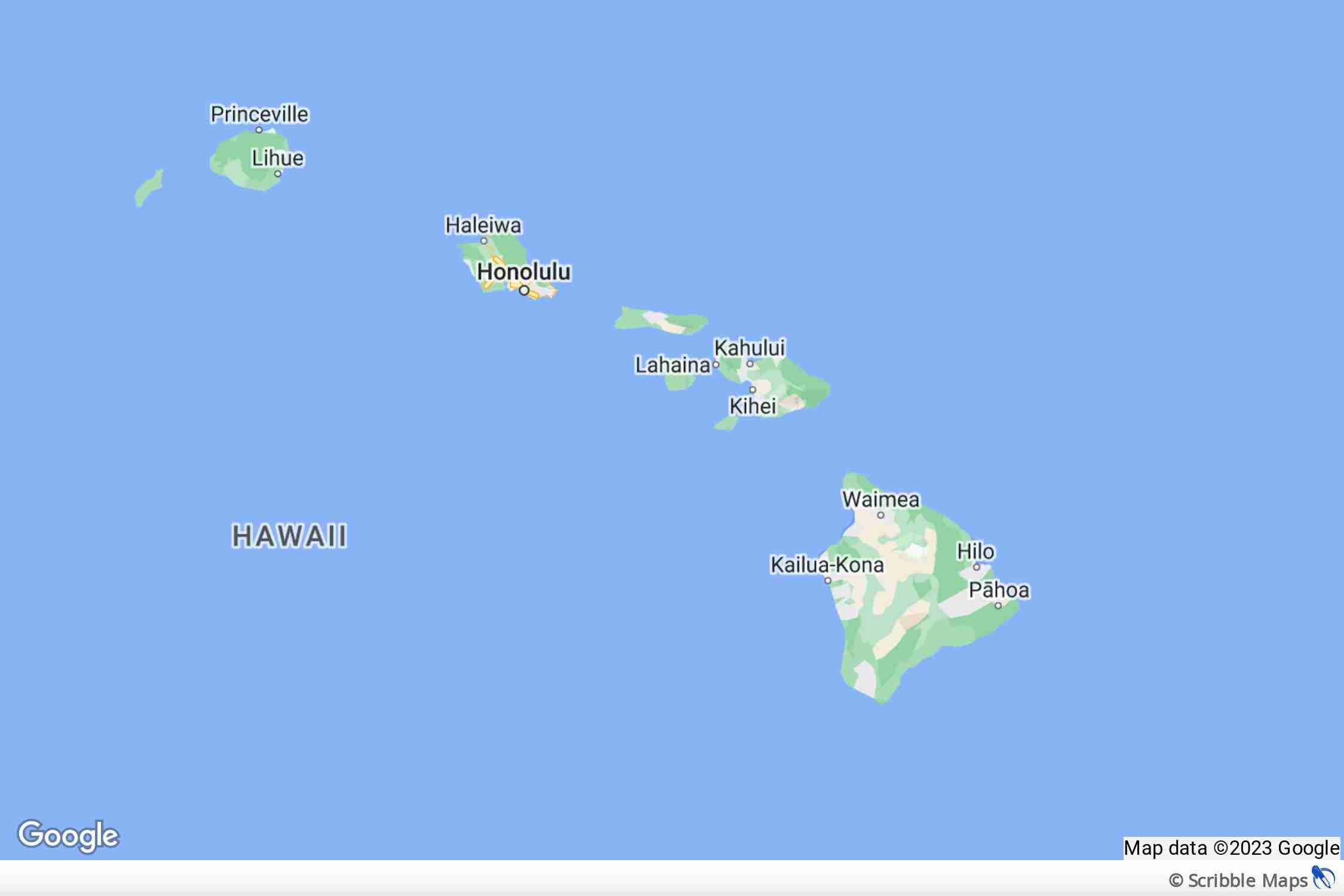
Hawaii is located approximately 2,500 miles from the continental United States, depending on the specific location on the mainland. The closest point between Hawaii and the mainland is Cape Kumukahi on the Big Island and San Diego in California, over 2,100 miles away. The distance from the West Coast to Honolulu, the capital of Hawaii is typically between 2,500 to 2,600 miles, while the distance from the East Coast extends to approximately 5,000 miles. The table below shows the significant distances and flight times involved.
Starting Point | Destination | Distance | Flight Time |
San Diego | Honolulu, Hawaii | 2614 miles | 6 hours 10 minutes |
Los Angeles | Honolulu, Hawaii | 2558 miles | 5 hours 55 minutes |
Seattle | Honolulu, Hawaii | 2678 miles | 6 hours 10 minutes |
Chicago | Honolulu, Hawaii | 4246 miles | 9 hours 20 minutes |
New York | Honolulu, Hawaii | 4960 miles | 11 hours 5 minutes |
Hawaii’s remote setting and location mean there’s a very limited number of ways to get there. However there’s still a few options open to you, particularly if you’re not limited by time or costs.
The most common and reliable way to get to Hawaii is by air. There are several airlines that offer direct flights from major cities in the United States, Canada, Asia, and other parts of the world. Most flights to Hawaii arrive at Honolulu International Airport on Oahu, but there are also airports on Maui, Kauai, and the Big Island. Visitors to Hawaii can choose from several airlines, including Hawaiian Airlines, United Airlines, Delta Airlines, American Airlines, and Alaska Airlines, among others. Flight times from the West Coast of the mainland United States to Hawaii are typically around 5 to 6 hours, while flights from the East Coast and Asia can take over 10 hours.
There are no regular ferry services between Hawaii and the Continental United States, although there are some limited options for sea travel. One option is to take a cruise ship to Hawaii from the West Coast (LA, Seattle, Vancouver) or other parts of the Pacific. Several cruise lines offer itineraries that include stops in Hawaii, allowing visitors to explore multiple islands during their trip.
It’s also possible to travel to the islands by cargo ship, although sailings and availability can be sporadic. The cost of travelling by cargo ship will be well in excess of the cost of air travel, so this is really only an option for idealists! Lastly it’s technically possible to travel to Hawaii by private boat or yacht, although this requires significant planning, preparation and cost.
Separated from the U.S mainland by over 2,000 miles of open ocean, there are no direct road connections to Hawaii. Such a vast distance makes the idea of a bridge or tunnel completely unfeasible. To put the distance in some context, the longest bridge in the world, the Danyang–Kunshan Grand Bridge, is 102 miles long. The Channel Tunnel, which links Great Britain and France is just 31 miles long. Therefore don’t expect any road connections to Hawaii any time soon!
There are no ferries to Hawaii primarily due to the significant distance between Hawaii and the mainland United States. The journey from the mainland to Hawaii by ferry would require crossing over 2,000 miles of open ocean. This area of ocean also presents challenging conditions including high winds, strong currents, and large swells. The distance and ocean conditions would make it difficult for ferries to maintain a consistent schedule, while the sailing would take between 7 to 10 days to complete. The excessive travel time and cost of such a ferry would make it uneconomical, particularly when compared to other forms of transportation, such as air travel.

It is possible to ship a car to Hawaii, but the process can be complex and expensive. Depending on your circumstances, it might be both cheaper and easier to rent a vehicle on arrival to Hawaii.
Here is an overview of the costs, timescales, and process involved for shipping a car to Hawaii:
Costs: The cost of shipping a car to Hawaii varies depending on several factors, such as the size and weight of the car, the departure and arrival ports, and the shipping method. Generally, the cost of shipping a car from the West Coast of the mainland United States to Hawaii ranges from $1,000 to $1,500. However, prices can be higher depending on the specific circumstances.
Timescales: The timescale for shipping a car to Hawaii depends on the departure and arrival ports, as well as the shipping method. Generally, shipping by container takes longer than shipping by roll-on, roll-off (RoRo) vessel. Shipping by container typically takes around 2 to 4 weeks, while shipping by RoRo vessel can take as little as 7 days. It’s important to note that timescales can vary due to weather conditions and other factors.
Process: The process of shipping a car to Hawaii involves several steps. First, the car must meet Hawaii’s Department of Agriculture’s quarantine regulations, which require an inspection and certification process to ensure that the vehicle is free of pests and diseases. Next, the car must be prepared for shipping by draining all fluids, disconnecting the battery, and securing loose parts. The car must then be transported to the departure port and loaded onto the shipping vessel. Upon arrival in Hawaii, the car must go through another inspection process and meet Hawaii’s safety and emissions standards before it can be registered and driven on the roads.
In summary, shipping a car to Hawaii is possible, but it can be complex and expensive. Costs can range from $1,000 to $1,500, timescales vary from 7 days to 4 weeks, and the process involves meeting Hawaii’s quarantine regulations, preparing the car for shipping, and passing inspection upon arrival. It’s important to research and plan carefully to ensure a smooth and successful shipping process.
Driving in Hawaii is no different to any other US state. cars drive on the right hand side, speed limits are in miles per hour and the same rules of the road apply. If you’re a US National and planning to drive in Hawaii, make sure to bring your driving licence as you’ll need to hire a vehicle. If you’re using a foreign drivers licence, you’ll also need to bring an international driving permit.


